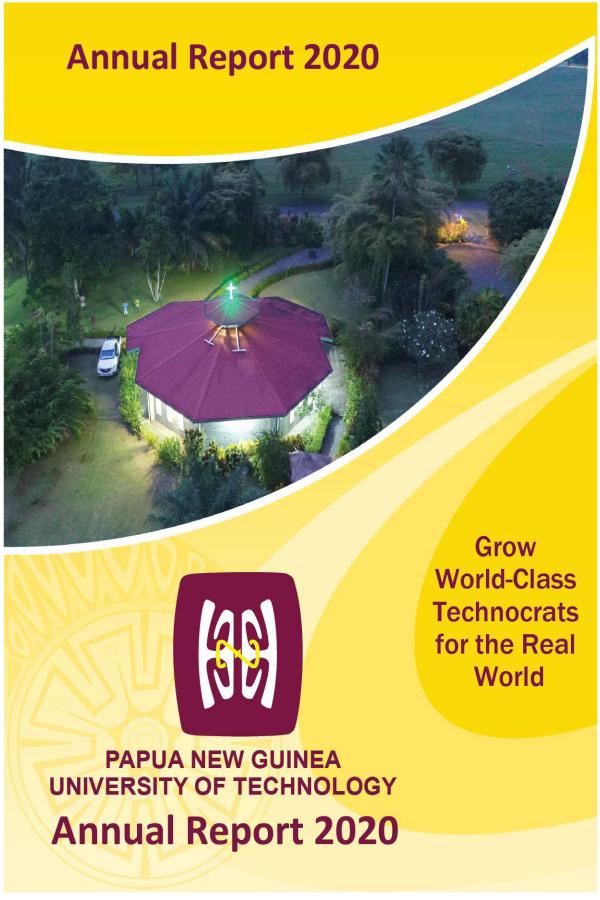
Papua New Guinea University of Technology Annual Report 2020
Synopsis
Vice Chancellor's Overview
This is the first time PNGUoT has prepared an Annual Report and I am very delighted that the report comes at a time when PNGUoT has, once more, secured a sense of direction with the launching of the Strategic Plan 2020 - 2024 in July 2020 that encapsulates the ideals of our envisioned future. Much of the preparatory work, done by key Council and Executive Management members (leading up to the final strategy) was based on review and assessment of reports from consultants and external institutional auditors as well as in-house SWOT analysis of Unitech as an organization.
PNGUoT's Strategy for development comes with a Vision to grow world-class technocrats by 2024 enacted by a Mission to develop such world-class technocrats through high-quality experiential teaching, research, and ardent applications of science, technology, and innovation for the 'real world'. Our Mission is supported by seven Strategic Domains or Foundational Pillars. The Domains are;
(1) Institutional Leadership and Governance,
(2) Academic Excellence
(3) Research, Innovation and Training
(4) Organizational Effectiveness and Performance
(5) Access, Externalization and Infrastructure
(6) Financial Sustainability
(7) Community, Industry and International Partnerships.
Our values include high ethical standards, professionalism, diversity and inclusivity, innovation and initiative, plus pride and passion. PNGUoT is also committed to ensuring that students develop academic and personal qualities and graduate with attributes as being:
(a) A life-long learner
(b) A critical thinker
(c) An effective communicator
(d) A cultural modernist
(e) Morally upright and
(6) Technologically savvy.
The new Council membership (introduced in 2013 after the 2012 crisis) consisted of highly reputablepersons who provided stable governance for the institution. Sir Nagora Bogan, who was Chancellor from 2013 - 2017, led the restoration of stability in governance with observance of policy, processes and procedures with accountability and visibility. Dame Jean Kekedo participated actively ensuring that the best persons were appointed to key executive positions at the University. Dame Kekedo's services continued with her elevation in 2017 to the position of Chancellor, whose term is still current.
We are grateful to the other present members of the Council who have taken to heart the concerns of the University and are actively engaged in policy formulation and decision making on governance issues.
Sir Bogan is especially acknowledged for his efforts in guiding and drafting the Strategic Plan 2020 -2024. While some confusion over the appointment procedures of leadership at Council and Executive Management levels remains, it is expected that these matters will soon be resolved Concerning Domain 2 on Academic Excellence, PNGUoT is making good progress on accreditation of the engineering programs. PNGUoT is already been granted provisional accreditation by Engineers Australia. The Dean of Engineering, Dr. Moses Kavi, is working closely with the University Management to ensure that the strategy adopted to achieve objectives required for full accreditation is in order.
Associate Professor Augustine Moshi, the PVC Academic, is to be commended for his steadfast and meticulous attention to detail related to the accreditation program. I also commend the Industry Advisory Board, under the leadership of Mr. Luke Liria representing Kumul Petroleum Holdings Limited (KPHL), who have financially supported the University to secure laboratory equipment. Other companies represented on the lAB include ExxonMobil, Oil Search, Ok-Tedi, Newcrest, and the PNG Institute of Engineers. I expect that all other degree courses of the University will also be similarly accredited or benchmarked to international or industry standards in the near future.
The Academic Quality Assurance Team of PNGUoT has also been active and has been conducting an assessment to ensure that staff are delivering quality teaching and learning to students. This includes the preparation of subject files for each unit and assurance that all learning materials are digitally available to all students. The Teaching & Learning Methods Unit (TLMU) is tasked to provide training to staff with skills for students centered learning with a focus to inculcate the graduate attributes among all students.
The ultimate goal of PNGUoT is to be the hub of science and technology for PNG and the Asia-Pacific region. This will be achieved through research, innovation and the application of knowledge generated to provide solutions to issues arising from within industry and communities.
We also have the largest post-graduate program in the country with over 200 students. Our research program topics are in Agriculture, Forestry, Fisheries, Energy, Engineering (Mining, Mineral Processing, Electrical, Civil and Mechanical), Environmental, Physical and Chemical Sciences, Climate Change, Building Construction and Architecture, Information Technology, Surveying and Geographical Information Systems and Communication for Development. PNGUoT is, in turn, building academic staff capacity with the recruitment of our graduates qualifying with Masters and PhD degrees.
PNGUoT is making headway in automating its learning and management systems. UNI 10 is a learning management system that has recently been installed to integrate various students' records including admission, registration, examinations, transcripts and boarding and lodging into one platform for ease of operations. This system will later be interfaced with the PNGUoT accounting system to manage online fee payment and finances. The Registrar's Office has employed the iChris platform to automate and manage HR services including recruitment, contracts and performance of staff. Academic staff are using
Google Classroom to manage teaching and learning for students. Given the challenges posed by the onset of COVID-19, staff are now using Zoom for interactive teaching with students online. Part of this Strategy assumes the provision of effortless internet access. While PNGUoT did have a network capacity, it only delivered an 80Mbps with a Wi-Fi coverage barely reaching staff residencies and students halls of residence. The COVID-19 crisis has impacted the teaching and learning delivery methods between all staff and students and thus compelled the management to invest in the expansion of the internal internet network to transmit wider bandwidth of 200Mbps through a bigger in-house optic fiber network, along with a wider Wi-Fi network reaching all students and staff with stronger signals. PNGUOT projected a student intake of 15% for 2020 in alignment with the strategy to expand access. However, with the introduction of the student Higher Education Loan Program (HELP), more students were able to obtain government loans to pay school fees. The total increase in intake was therefore 30% compared to 2019, which has brought up the total undergraduate student numbers to 3000. This increase exhausted all the dormitory space available to students.
Bed spaces had been reserved for TESAS students; however, due to the reduced number of TESAS qualifying students, more spaces became available. These extra dormitories were all taken up by self-sponsored students contributing to increase in internal revenue for the University.
Furthermore, PNGUoT is currently externalizing its courses through a satellite campus and is planning to deliver more courses online. These actions will allow us to expand intake in 2021 and beyond. The University has struggled to secure PIP funding for new dormitories and cannot presently accommodate these increasing number of students on the main campus. Every effort is thus being made to secure K 10 million funding from Incentive Fund to build a 150-bed dormitory for female students
In terms of infrastructure, PNGUoT has now turned the corner towards financial stability. It began when the Council resolved not the renew the student messing contract to iPi Catering Ltd at the end of 2019. Since in-sourcing of catering, the Management has annual savings of nearly K 6 million per year. These savings have been used elsewhere including maintenance of our aging infrastructure, increasing funding to our research activities, community development programs and ICT and Library improvement services. Solar street lights have been installed to improve security. CCTV cameras have been installed in the mess and the main gate and work on the students' residences border with the settlements are ongoing.
Sincerely,
Associate Professor Ora Renagi OL PhD
Vice Chancellor
Downloads
Published
Series
Categories
License

This work is licensed under a Creative Commons Attribution-NonCommercial-NoDerivatives 4.0 International License.